By Gregg Boll, Director of Missions
In part 1 of this article, I will take an honest look at the health and troubling trends of membership and giving in the SBC and among our churches. In part 2, I will further describe some of the societal and spiritual reasons for the decline of our faith family, Southern Baptists. I will also share some of the cultural and demographic shifts that have affected the strength of our churches and thus the entire Southern Baptist Convention. In part 3, I will share some simple, practical things churches can do to be proactive in their mission rather than reactive in getting ahead of the negative pressures that are impacting our churches. I’ll share how we, BR-KC, can come alongside your church in developing better systems and a healthier culture of discipleship and evangelism.
I’ve adopted a new phrase I like to use to preface things I’m about to say, so that people know where I’m coming from and the spirit with which I mean something: “I’m not complaining, just reporting.” Everything I say in this article, I hope you hear as me just reporting, not complaining, and certainly not accusing.
I’m also not attempting to be overly alarmist or pessimistic. I’ve heard my grown children say more than once to me after giving them my assessment of a situation, “Dad, you’re such a pessimist!” To which I respond, “No, I’m just a realist.” Church and denominational leaders need to be more honest than ever in addressing the issues facing our churches.
It’s time for an honest conversation about cooperation among Baptists. It’s time for an honest conversation about the state of our faith family, Southern Baptists.
Here’s the hard, sad truth. Christian Denominations in the United States are declining, and our faith family, Southern Baptists, is no exception. There, I said it. This past week was our annual Missouri Baptist Convention. We heard a dozen reports from denominational leaders, and most were cheery and positive. I’ve attended these meetings at the state and national level for several decades. While I love good news and want to know of mission successes at home and abroad, I do weary of denominational leaders not leveling with us and telling us the truth about our true condition. We wouldn’t want our medical doctor to only point out positive aspects of our overall health, yet fail to inform us of a life-threatening condition. Even more troubling is that denominations are only as strong and healthy as the total of the individual churches that comprise them. So, denominations are declining because thousands of churches across America are declining. So, to be fair to our denominational leaders, we appoint and elect; if they were brutally honest, they would have to say, “Hey, our convention, agency, board, committee, or seminary is only as strong as the people and resources you are sending us to work with.”
This isn’t about assigning blame. It’s about a plea for honesty among our churches, pastors, and our denominational leaders. We can’t address problems we are unwilling to identify and acknowledge. We need some people in our faith family to have the boldness and prophetic spirit of Nathan to say to our churches, our faith family, yea to ourselves, “Thou art the man.” We’re in this together. This isn’t someone else’s problem. It is our problem.
So, what does the data actually show about the state of our denomination? Here are a few of the highlights…..or lowlights:
1. Membership among our SBC Churches has been on an 18-year decline. Take a look at the following graph of membership from Lifeway Research:
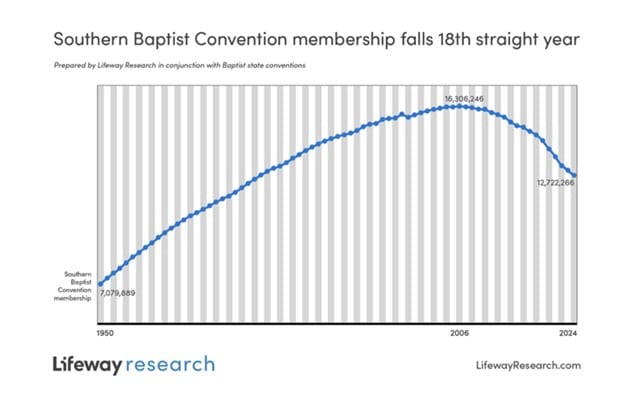
This graph is through the end of 2024’s recorded data. It will be interesting to see if our declining membership continues throughout 2025 when the data is reviewed in a few months. In part two of this article I will give some of the reasons for falling attendance in our SBC Churches.
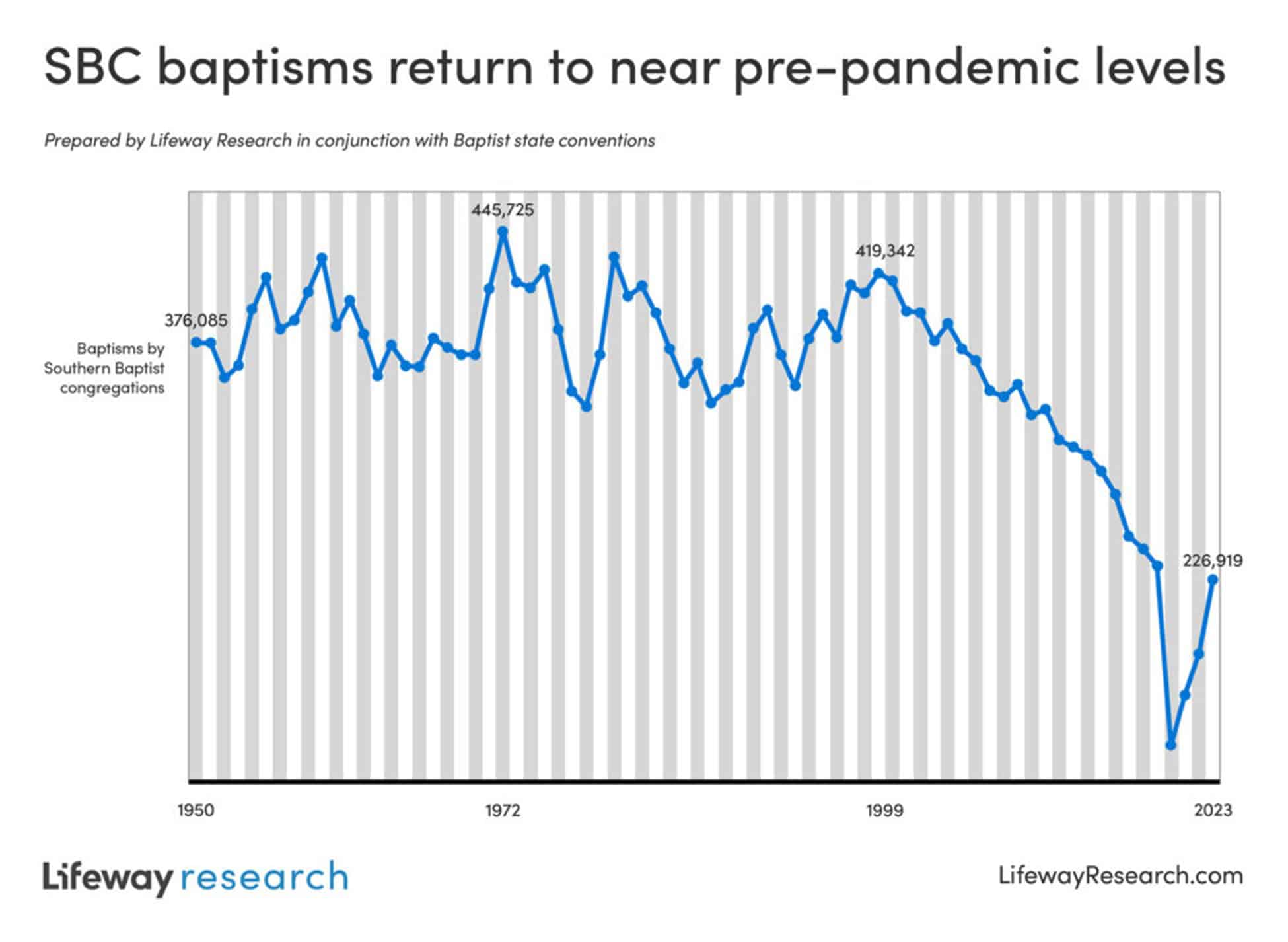
2. While baptisms have been declining since 1999/2000 for our SBC Churches, they have been on the rise since the low point of the Covid pandemic and are now near pre-pandemic numbers. Aaron Earls of Lifeway Research writes, “On any given week last year (2024), 4,050,668 individuals attended a congregation affiliated with the Southern Baptist Convention, an increase of 246,178 over 2022 for a more than 6% jump. Further, Michael Gryboski, editor of the Christian Postm, cites Lifeway Research data which show that the SBC had approximately 12.72 million members in 2024, a 2% decline from the approximately 12.98 million reported for 2023.
While membership was down, the news about baptisms was better. The SBC saw 250,643 baptisms in 2024, which was about 10% more than the 226,919 that occurred in 2023, itself a rise from 2022, when the nation’s largest Protestant denomination reported fewer than 200,000 baptisms. So, to recap, membership continues to decline, attendance in SBC Church services and baptisms are up slightly.
3. The third observation is that giving of our SBC Churches to the Cooperative Program unified budget has declined in seven of the past 10 years, with receipts for the year just ended being 4.4% less than a decade ago. Mark Wingfield of Baptist Net Global comments, “When you consider that inflation in the United States over the past decade has increased prices (the cost of ‘doing church’) by about 36.7%, this means that SBC entities and your church have 40% less buying power than we did a decade ago.” Again, the decreases in giving to and through the Cooperative Program to our denominational entities and ministries, such as the I.M.B., NAMB, our six seminaries, the ERLC, and Guidestone, are merely a reflection of the decreases in giving/revenues to our Southern Baptist churches. As we often say, the denominational entities and ministries are downstream from our churches’ giving. When the stream is stronger upstream among our churches, the giving downstream to the Cooperative Program is stronger. This is true for Associations, as well. BR-KC has experienced a gradual decline in giving from our churches. Our revenues mirror the trend of the revenues and giving coming to our 120 BR-KC member churches. Consider the last five years of giving to BR-KC from our churches:
2020 – $463,000
2021 – $450,000
2022 – $437,000
2023 – $417,000
2024 – $406,000
I would like to believe that this decline is not due to any lack of confidence in the value we bring to our pastors and churches or any loss of trust in how we steward the funds you send us. Rather, as I work with several of our churches each year, I see that decreased giving to the Association or Cooperative program is a direct result of churches shrinking annual budgets, the decline and loss of churches closing their doors over time. It is because churches are experiencing an astronomical rise in insurance rates, maintenance costs, utilities, and other costs necessary to “do church”. Again, BR-KC is downstream from our churches. In part 2 I’ll discuss reasons why reduced giving to denominational organizations is partly caused by an growing tribalism within the SBC.
Finally, you must acknowledge that your church is downstream from the individual members of your church who have also encountered hyperinflation and rising costs of living over the past several years. I realize that your church has been faced with hard decisions about what to cut to bring your budgets in line with real revenue and increasing costs. I also realize that sometimes what churches decide to cut in their budget is giving to gospel partners like the SBC, MBC and the local Association to adequately fund their own ministries.
I would just add that BR-KC is a beneficiary of three foundations/trusts that provide a marginal amount of revenue each year, which helps supplement our revenues and meet budgetary needs. Still, the trend in decreasing giving from our churches cannot continue indefinitely and will eventually impact our ministry to churches and pastors.
Remember, I’m not complaining, just reporting.
In the midst of the above bad news, let me remind you of the good news. We serve the Lord, and one of the many names He is known by is Jehovah Jireh, meaning “the Lord will provide.” A wise old believer once said to me, “Gregg, there is the economy, and then there is God’s economy.” He was right. We serve a Lord who is not limited in power or resources. He created all things for His own glory and disperses them generously among His people, who are the sheep of His pasture. He can do exceedingly, abundantly more than we ask or think. He provides blessings, pressed down, shaken together, and running over. He can replenish the widow’s barrel of meal and cruse of oil indefinitely, as He did for the widow of Zarephath. He can multiply a few loaves and fish to feed thousands. Friend, “Look up, for thy redemption draweth near” and “salvation is nearer to us than when we first believed.” (Luke 21:28, Romans 13:11)